MATH LEADERSHIPTHE PLAYBOOK

Now available · Paperback & Kindle

FOR THE LEADERS WHO SHAPE WHAT’S NEXT

The Math
Leadership
Playbook.

for the Modern Quantitative Era

The coaching conversations, curriculum choices, and course pathways you lead decide who gets access to mathematics. This is the playbook for making them work together.
Buy the paperback Kindle edition
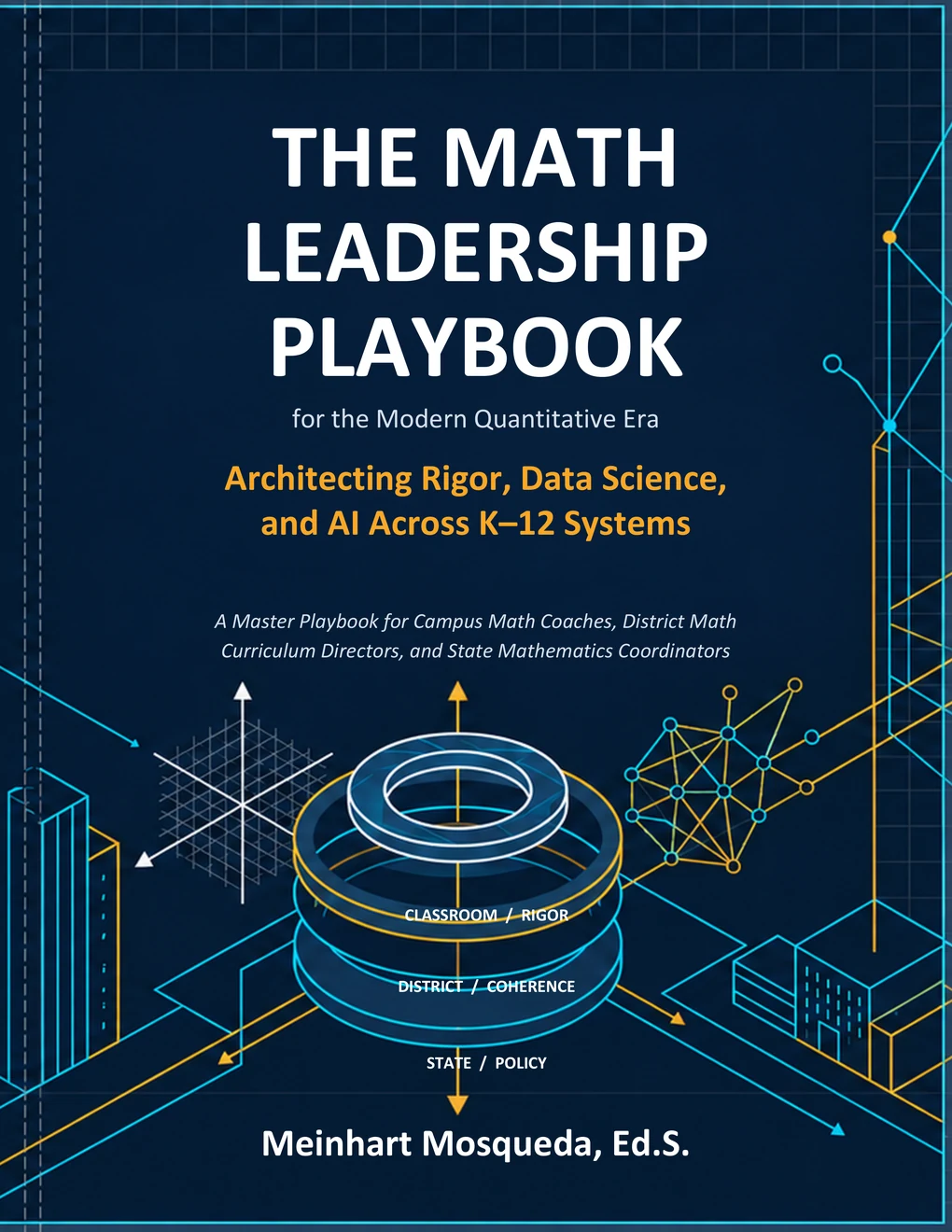
The Math Leadership Playbook for the Modern Quantitative Era by Meinhart Mosqueda, Ed.S. Blueprint-style navy cover with white and orange lettering and a stacked Classroom, District, and State diagram.

RIGOR. COHERENCE. OPPORTUNITY.

520full-color pages
28chapters
28Survival Toolkits with practical next steps
3levels of the system: campus, district, state

A WIDER VIEW OF MATHEMATICS LEADERSHIP

Better instruction begins
with the systems around it.

Every curriculum decision, coaching conversation, and course pathway shapes what students can learn. This playbook connects those decisions, giving mathematics leaders a practical way to move from isolated initiatives to coherent action.

SOUND FAMILIAR?

The hardest problems in math
leadership aren’t in one classroom.

The new curriculum arrived. Practice didn’t change.

High-quality materials were adopted, but classroom tasks, feedback, and pacing still look the way they did before.

Placement is decided in minutes, from a spreadsheet.

A single eighth-grade course decision quietly shapes a student’s path to calculus, and it is rarely revisited.

AI tools are arriving faster than guidance.

Adaptive software and AI promise support, but few leaders have a clear lens for judging their effect on cognitive demand.

INSIDE THE PLAYBOOK

From daily decisions
to lasting change.

Four connected domains of work, for leading mathematics across classrooms, schools, districts, and state systems.

01Build instructional coherence

Align curriculum quality, vertical learning progressions, and classroom practice. Bring greater focus to the choices that connect one grade, and one learning experience, to the next.

  • High-quality instructional materials
  • K–12 curricular coherence
  • Conceptual understanding and fluency
02Make coaching actionable

Connect classroom observations, student thinking, and professional learning. Use evidence to guide feedback and keep improvement grounded in the work students actually do.

  • Learning walks and calibrated feedback
  • Mathematical discourse
  • PLCs and error analysis
03Lead data science and AI thoughtfully

Examine emerging pathways and tools through the lens of mathematical reasoning. Consider how data science and AI can support learning, and what leaders need to evaluate before adoption.

  • Data science pathways and curriculum
  • AI-supported coaching and preparation
  • Adaptive software and cognitive demand
04Design systems for opportunity

Look closely at the structures that shape access: course placement, intervention schedules, assessment, and policy. Connect improvement efforts with students’ mathematical identity and agency.

  • MTSS and intervention architecture
  • Assessment integrity and course pathways
  • Equity and continuous improvement

WHAT YOU’LL WALK AWAY WITH

Clarity you can
act on Monday.

Written by a practitioner who has worked on standards revision and curriculum adoption at the state level, for leaders who have to turn those decisions into classroom reality.

ONE PLAYBOOK. THREE LEADERSHIP PERSPECTIVES.

Your role is different.
The work is connected.

CAMPUS

Math coaches

Bring clarity to instructional feedback, professional learning, and the daily work of helping teachers strengthen mathematical thinking.

DISTRICT

Curriculum directors

Connect curriculum, assessment, intervention, and teacher development into a coherent K–12 mathematics program.

STATE

Mathematics coordinators

Translate standards, assessment expectations, and policy into guidance that supports meaningful work in schools.

FROM THE FOREWORD

“A young person can spend four years earning passing grades, be told every quarter that they are meeting expectations, and arrive at graduation having practiced a version of mathematics that does not open the door the diploma implies.”

The Moral Horizon of Quantitative Leadership

Portrait of Meinhart Mosqueda, Ed.S.

ABOUT THE AUTHOR

Meinhart Mosqueda, Ed.S.

Physicist. Teacher. System leader.

Meinhart (“Mike”) Mosqueda has spent his career where mathematics is put to work: the physics laboratory, the secondary classroom, and the rooms where state standards are written and instructional materials are judged. He began in high-energy physics, building computational models for cosmic-ray detectors while teaching university physics, then spent fifteen years teaching secondary mathematics, physics, chemistry, computer science, and robotics across three states.

Today, as a statewide Education Specialist, he provides technical assistance and oversight for 6–12 mathematics programs and has helped lead the revision of statewide mathematics standards and the adoption of high-quality instructional materials.

  • Association of State Supervisors of Mathematics (ASSM)
  • National Council of Supervisors of Mathematics (NCSM)
  • Smarter Balanced Mathematics Advisory Council

FOR BOOK STUDIES & LEADERSHIP TEAMS

Read it together in the
Playbook Study Room.

A free online companion for the book: chapter guides, interactive toolkits, facilitator session plans, and a shared reflection board for your group.

Enter the Study Room

THE MATH LEADERSHIP PLAYBOOK

A resource for the work
ahead of you.

A Master Playbook for Campus Math Coaches, District Math Curriculum Directors, and State Mathematics Coordinators.
Format
Color paperback · Kindle
Length
520 pages
Trim size
8.5 × 11 inches
Status
Available now

Get your copy.

Available now on Amazon in two editions.

Ordering for a team or district?

Ask about copies for your leadership team, book-study support, or a workshop. No spam.

Front cover of The Math Leadership Playbook
FRONT · click to enlarge
Back cover of The Math Leadership Playbook: Lead mathematics learning across the whole system. Descriptions for campus math coaches, district curriculum directors, and state mathematics coordinators; 28 chapters and 28 Survival Toolkits; and an author biography.
BACK · click to enlarge

ALSO BY MEINHART MOSQUEDA

Keep building.

See the full collection →

Buy on Amazon ↗

A LOOK INSIDE

The Moral Horizon of
Quantitative Leadership

Excerpt from the foreword

A decision gets made about a thirteen-year-old every spring, usually in a few minutes, usually by an adult reading a spreadsheet. The student is placed into one eighth-grade mathematics course rather than another. Nobody in the room describes what they are doing as allocating that child's access to an engineering degree, a nursing license, a quantitative career, or a seat in a state university. But that is the effect, and everyone involved knows it, which is why placement conversations are the tensest meetings in an American secondary school.

Mathematics is the mechanism by which opportunity is rationed in American schooling. This is not a claim about the discipline's beauty or its cultural prestige. It is a description of institutional plumbing. Course sequences are chained: the course a student takes in Grade 8 determines what is available in Grade 9, which determines what is available in Grade 11, which determines what a transcript can show an admissions office. No other subject has this property to the same degree. A student who arrives late to strong writing instruction can still write well by senior year. A student who is placed off the algebra sequence in middle school is, in most districts, structurally excluded from calculus before they have finished growing. The sorting happens early, it compounds annually, and it is almost never revisited.

That would be defensible if the sorting were accurate and if what followed the sort were good. Neither is reliably true.

Keep reading in the full book.

Get the paperback ↗

Meinhart Mosqueda, Ed.S. · The Math Leadership Playbook